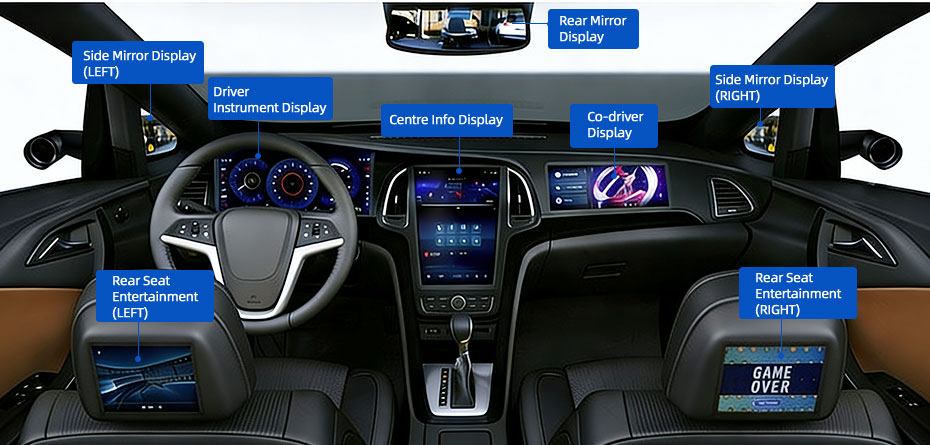
Walk into a modern vehicle and you will quickly notice how much information is now presented through displays.
The traditional instrument cluster has become a digital display. Center consoles are getting larger and more interactive. Rear-seat entertainment, camera monitoring, navigation, vehicle settings and driver assistance systems all rely on visual interfaces.
With OLED, Mini-LED and MicroLED receiving increasing attention, it may seem that LCD technology is gradually becoming outdated.
In automotive applications, however, the situation is quite different.
In 2026, LCD displays remain a practical and widely used choice for automotive display applications. Their combination of brightness, reliability, cost efficiency, wide temperature capability and flexible product options continues to make TFT LCD attractive to vehicle manufacturers and system designers.
For many automotive projects, the question is no longer whether LCD technology is old or new. The more useful question is whether an LCD display can meet the actual requirements of the vehicle.
In many cases, the answer is still yes.
Why Automotive Displays Have Different Requirements
A car is a much more demanding environment than a typical consumer electronic device.
A smartphone may be used for several hours a day. An automotive display can remain active whenever the vehicle is running and may need to operate reliably for many years.
It can also be exposed to direct sunlight, large temperature changes, vibration and continuous use.
This means an automotive LCD display needs to balance several factors at the same time.
Brightness is important for daytime visibility. Wide temperature operation is important for vehicles operating in both cold and hot climates. Viewing angle matters because the driver and passengers may view the same screen from different positions.
Mechanical dimensions, interface compatibility, touch functionality and long-term availability also have to be considered during product development.
This is where the maturity of TFT LCD technology becomes a real advantage.
LCD Offers a Mature Solution for Automotive Applications
One reason LCD continues to be widely used in vehicles is simple: the technology is mature.
Manufacturers have extensive experience producing TFT LCD panels in different sizes, resolutions and configurations. This makes it easier for automotive display suppliers to develop solutions for different vehicle platforms.
An automotive display does not always need to be a large, ultra-high-resolution panel.
A motorcycle dashboard may require a compact display. A commercial vehicle may need a rugged 7-inch or 9-inch panel. A passenger vehicle may use a large center display or a long bar-type display.
LCD can cover this wide range of applications.
EUROTECH's automotive LCD portfolio includes compact 4.3-inch displays as well as larger 12.3-inch and 16.2-inch automotive panels, showing how different LCD formats can be adapted to different vehicle interfaces.
High Brightness Is One of LCD's Biggest Advantages
One of the most important specifications for an automotive display is brightness.
A vehicle may be driven under strong sunlight, and sunlight entering through the windshield can significantly reduce the perceived contrast of a conventional display.
This is why high brightness automotive LCD displays are increasingly important.
Depending on the application, automotive displays can be designed with brightness levels from several hundred nits to well above 1000 nits.
EUROTECH offers automotive LCD products with 800-nit, 1000-nit and 1200-nit brightness levels. Its ET070FH01-H 7-inch FHD display reaches an exceptionally high 4500 nits and combines MIPI connectivity with In-Cell touch.
This type of high-brightness LCD is particularly useful for displays that need to remain readable in strong ambient light.
But brightness should not be considered by itself.
For good outdoor and automotive visibility, engineers also need to consider contrast, viewing angle, surface reflection, anti-glare treatment and the optical structure of the complete display.
Wide Temperature Operation Matters in Real Vehicles
Temperature is another major consideration.
A vehicle parked outdoors can experience very different conditions throughout the year. The display may need to start in freezing weather and continue operating after the cabin becomes extremely hot.
For this reason, wide temperature LCD displays are widely used in automotive applications.
Depending on the design, automotive LCD products may support operating ranges such as -30°C to 85°C or even wider.
For example, EUROTECH's 4.3-inch ET043WV01-ZK supports operation from -30°C to 85°C, while several automotive panels in its portfolio are also designed around extended temperature ranges.
For vehicle manufacturers, this is more than a specification on a datasheet. It directly affects how reliably the display can operate in the finished vehicle.
IPS TFT LCD Provides Wide Viewing Angles
Automotive displays are rarely viewed from exactly the same position.
The driver may look at the instrument cluster straight on, while the passenger may view the center console from an angle.
This makes viewing angle an important part of automotive TFT LCD selection.
IPS technology is often preferred when wide viewing angles and consistent image quality are required.
EUROTECH's automotive LCD portfolio includes wide-viewing-angle products. The ET043WV01-ZK, for example, provides 80/80/80/80 viewing angles, while the ET070FH01-H offers 85/85/85/85 viewing angles.
For automotive HMI applications, this helps maintain a consistent image when the screen is viewed from different positions.
LCD Can Support Different Automotive Display Formats
Another reason LCD remains relevant is its flexibility in screen design.
Modern vehicles are not limited to conventional 16:9 displays.
Designers may require:
· Standard rectangular displays
· Wide bar displays
· Tall portrait displays
· Compact dashboard displays
· Large center information displays
· Custom aspect ratios
EUROTECH's product range includes unusual automotive display formats as well. The ET088WF01-TT, for example, uses a tall 480 × 1920 resolution and a 1:4 aspect ratio, while the AV162YUM-N10 uses a 2608 × 720 ultra-wide format with an aspect ratio greater than 3:1.
This type of flexibility is useful when the display needs to fit a specific dashboard or instrument panel design.
Automotive LCD Is Not Limited to Traditional Low-Resolution Panels
There is sometimes a misconception that LCD is mainly associated with older, low-resolution displays.
That is no longer accurate.
Modern TFT LCD products are available with HD, Full HD and higher resolutions.
For example, EUROTECH's ET070FH01-H provides 1920 × 1080 resolution on a 7-inch panel, while the 16.2-inch AV162YUM-N10 provides a 2608 × 720 ultra-wide resolution.
The appropriate resolution depends on the application.
A digital instrument cluster may require high pixel density for sharp text and graphics. A simple vehicle control interface may not need the same resolution.
Selecting the right resolution is therefore more important than simply choosing the highest possible specification.
LTPS LCD Is Pushing Automotive LCD Further
LCD technology is also continuing to evolve.
One important development is LTPS, or Low-Temperature Polycrystalline Silicon.
Compared with conventional amorphous silicon TFT technology, LTPS can provide higher electron mobility, which makes it suitable for applications requiring higher resolution, improved pixel performance and potentially lower power consumption.
This makes LTPS LCD particularly interesting for advanced automotive displays.
Instead of viewing LCD as a fixed technology, it is more useful to think of it as a platform that continues to develop.
The automotive market can therefore adopt improved LCD technologies without completely changing the underlying display ecosystem.
Mini-LED Backlighting Is Giving LCD Another Option
Mini-LED is another technology changing the conversation around LCD.
Mini-LED does not replace the LCD panel itself. Instead, it uses a more advanced backlight architecture with a much larger number of smaller LEDs and local dimming zones.
The result can be higher contrast, better black levels and improved HDR performance compared with a conventional LCD backlight.
For premium automotive displays, Mini-LED LCD can therefore provide a way to improve image quality while retaining the advantages of an LCD-based architecture.
This is particularly interesting for large center displays and high-end cockpit applications where both brightness and contrast are important.
LCD vs OLED: Which Is Better for Automotive Displays?
There is no universal answer.
OLED offers excellent contrast and very deep blacks because each pixel is self-emissive. It can also support thinner and more flexible display structures.
These characteristics make OLED attractive for premium automotive interiors.
LCD, however, remains highly competitive when the priorities are high brightness, cost control, wide temperature operation, long-term availability and a broad choice of sizes.
For many vehicle applications, these practical considerations can outweigh the visual advantages of OLED.
The decision should therefore be based on the environment and requirements of the finished vehicle rather than simply choosing the newest display technology.
Touch Integration Is Becoming Part of the Automotive Display
Today's vehicle displays are increasingly interactive.
Drivers and passengers may use the display to control navigation, media, climate, vehicle settings and other functions.
As a result, automotive display modules increasingly combine the LCD panel with touch functionality.
Common approaches include PCAP touch, In-Cell touch, On-Cell touch and customized cover glass solutions.
EUROTECH's ET070FH01-H is a good example of this approach. It combines a 7-inch 1920 × 1080 TFT LCD, 4500-nit brightness, MIPI interface and In-Cell touch in one automotive display solution.
Integrating these functions can help reduce the number of separate components and simplify the overall HMI design.
Interface Selection Is Important for Automotive LCD Design
The display interface should also be considered early in the development process.
Different automotive systems may use MIPI, LVDS, RGB, TTL or other interfaces depending on the processor and system architecture.
EUROTECH's automotive LCD products cover several interface options.
The ET043WV01-ZK uses TTL, while the ET070FH01-H uses MIPI. Other automotive panels in the EUROTECH portfolio use LVDS, including wide-format displays designed for vehicle applications.
Choosing the interface at the beginning of the project can help avoid unnecessary controller boards or PCB changes later.
What Should Engineers Consider When Choosing an Automotive LCD Display?
Selecting an automotive LCD is not simply a matter of choosing the correct screen size.
Engineers should first consider where the display will be installed and how it will be used.
For outdoor or high-ambient-light environments, brightness and optical performance should be high priorities.
For vehicles operating in extreme climates, operating temperature should be carefully checked.
For center consoles and shared displays, viewing angle becomes more important.
For touch-based HMI systems, the touch technology, cover glass and bonding structure need to be considered together with the LCD panel.
The mechanical dimensions are equally important. Active area, outline size, thickness, FPC position and mounting structure all need to fit the vehicle's interior design.
Finally, long-term supply should not be overlooked. Automotive products often have long development and production cycles, so display availability and supplier support can have a major impact on the overall project.
Why LCD Will Remain Important in Automotive Applications
The automotive display market is changing quickly, but that does not mean LCD is disappearing.
Instead, LCD is evolving alongside other display technologies.
High-brightness backlights are improving sunlight readability. IPS technology provides wide viewing angles. LTPS can support higher-performance applications. Mini-LED backlighting can improve contrast and HDR performance. Touch integration is making LCD modules more useful as complete HMI solutions.
At the same time, LCD retains the advantages that made it successful in the first place: mature manufacturing, broad size availability, competitive cost and strong application flexibility.
That combination is difficult to replace across the entire automotive market.
Choosing an Automotive LCD Display for Your Project
The best automotive display is not necessarily the display with the highest resolution, highest brightness or newest technology.
It is the display that fits the actual requirements of the vehicle.
For one project, a 4.3-inch 1000-nit wide-temperature LCD may be the right solution. For another, a 7-inch Full HD 4500-nit display with In-Cell touch may make more sense. A large vehicle dashboard may require an ultra-wide 12.3-inch or 16.2-inch LCD with LVDS connectivity.
EUROTECH provides a wide selection of automotive LCD displays, including high-brightness TFT LCD, wide-temperature LCD, IPS LCD, touch display and customized display solutions.
For automotive engineers and product developers, the most effective approach is to define the display requirements early and then select the LCD architecture around the actual vehicle environment.
LCD may not be the newest display technology.
But in 2026, it remains one of the most practical.
And for many automotive applications, practical performance is exactly what matters.
FAQ: Automotive LCD Displays
Are LCD displays still widely used in cars in 2026?
Yes. LCD remains an important display technology for automotive applications because it offers a mature supply chain, a wide selection of sizes and configurations, high-brightness options and strong reliability for demanding environments.
Why are LCD displays suitable for automotive applications?
Automotive TFT LCD displays can be designed with high brightness, wide viewing angles, wide temperature operation, touch functionality and different interfaces such as MIPI, LVDS and TTL.
What brightness is suitable for an automotive LCD display?
The required brightness depends on the location of the display and the surrounding lighting conditions. Automotive applications may use several hundred nits, while displays exposed to strong sunlight can require 1000 nits or significantly higher.
What is a wide-temperature automotive LCD?
A wide-temperature automotive LCD is designed to operate reliably across a broader temperature range than a typical consumer display. EUROTECH offers automotive LCD products supporting ranges such as -30°C to 85°C.
Is OLED replacing LCD in automotive displays?
OLED is growing in automotive applications, especially in premium vehicles, but LCD remains highly competitive. Improvements such as LTPS LCD and Mini-LED backlighting are also helping LCD address higher-performance applications.
Can an automotive LCD display include touch?
Yes. Automotive LCD modules can be combined with PCAP, In-Cell or other touch technologies. EUROTECH offers automotive displays with integrated touch solutions, including In-Cell touch products.